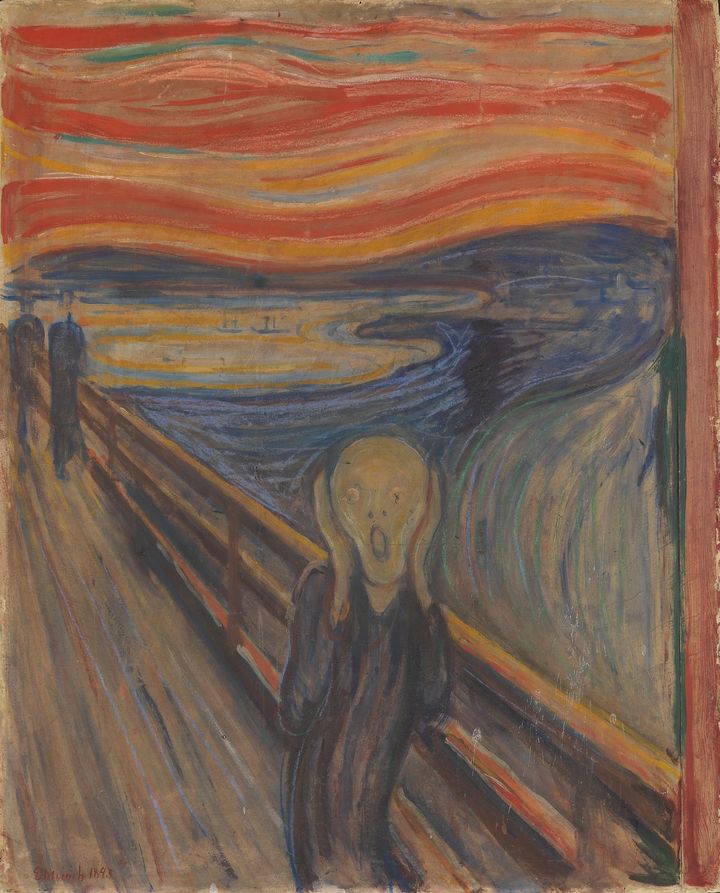
Edvard Munch The Scream, 1893

The Painter

Edvard Munch was five when his mother died of tuberculosis. He was thirteen when the disease took his sister Sophie too — the sister he was closest to, the one who'd sat with him through his own long childhood illnesses. His father, devout and prone to dark spells of depression, told the children their mother and sister were watching over them from heaven, a comfort Munch later said felt more like a threat. Another sister, Laura, would spend much of her adult life at Gaustad, the asylum on the edge of the city then called Christiania. Illness, in one form or another, was simply what Munch's family was made of — and it became, almost inevitably, what he painted.

The Moment

It was near Gaustad, on a path along Ekeberg hill above the fjord, that Munch was walking one evening with two friends when the sky, without warning, turned blood red. He stopped, leaning on a fence, while his friends walked on ahead. He felt, he wrote, "an infinite scream passing through nature" — not a sound he heard so much as one the whole world seemed to be making, and he was only standing in the middle of it, trembling. Whether something real sat underneath that vision — animal cries carried up from the slaughterhouse nearby, a voice from the asylum — no one can say for certain.

The Painting

What he made of that evening wasn't a record of a place but of a feeling, and it shows in every choice. The sky and fjord are painted in the same long, undulating strokes, so that sky, water, and hillside all seem to move together in one continuous current — the whole landscape caught in the same shudder as the figure in front of it. That figure is drawn almost boneless: a thin, wavering line for a skull-like head, hands pressed not over a scream coming out, but over one pouring in. Against all that motion, Munch set one rigid element — the bridge's railing, in hard straight lines pulling sharply into the distance — the one stable thing in the painting, and it only makes everything else feel less stable by comparison. Two figures walk on further up the bridge, upright, ordinary, entirely untouched — his friends, presumably, who in his diary "walked on" while he stood there alone. He returned to this same arrangement five more times over the next two decades — two paintings, two pastels, a lithograph — never quite satisfied he'd gotten the feeling exactly right.

Afterward

The best-known version — tempera and pastel on cardboard, 1893 — now hangs in the National Museum of Norway. It has been stolen twice and recovered twice: once in 1994, lifted from the gallery in broad daylight the same morning the Winter Olympics opened in Lillehammer; again in 2004, at gunpoint, from the Munch Museum. A pastel version, held privately for a century, sold at auction in 2012 for $119.9 million — at the time, the highest price ever paid for a work of art. Munch died in 1944, in Nazi-occupied Norway, largely alone at his estate outside Oslo, and left the city almost everything he'd made: over a thousand paintings, tens of thousands of prints and drawings. He had spent a lifetime painting one man's private collapse. Somehow, it became everyone's.