The right farm
The delivery note
Taped to the back of the stretcher is a delivery note from a canvas supplier in Pinetown: one canvas, 120 by 160 centimetres, four-centimetre depth, R2,340, paid cash, collected by customer. Ravelle Pillay fetched it in her mother-in-law’s Corolla, the only car in the family long enough, and drove home to Umbilo with the passenger seat pushed right forward and the top of the canvas resting on the dashboard.
She was thirty-seven. She cut mounts four mornings a week at a framing shop in Musgrave, and painted on the enclosed back stoep of the semi-detached house she rents with her husband, Dev, and his mother. The stoep also holds the washing machine. She painted from half past five until seven, and stopped when the machine went on.
Izotsha, 1931
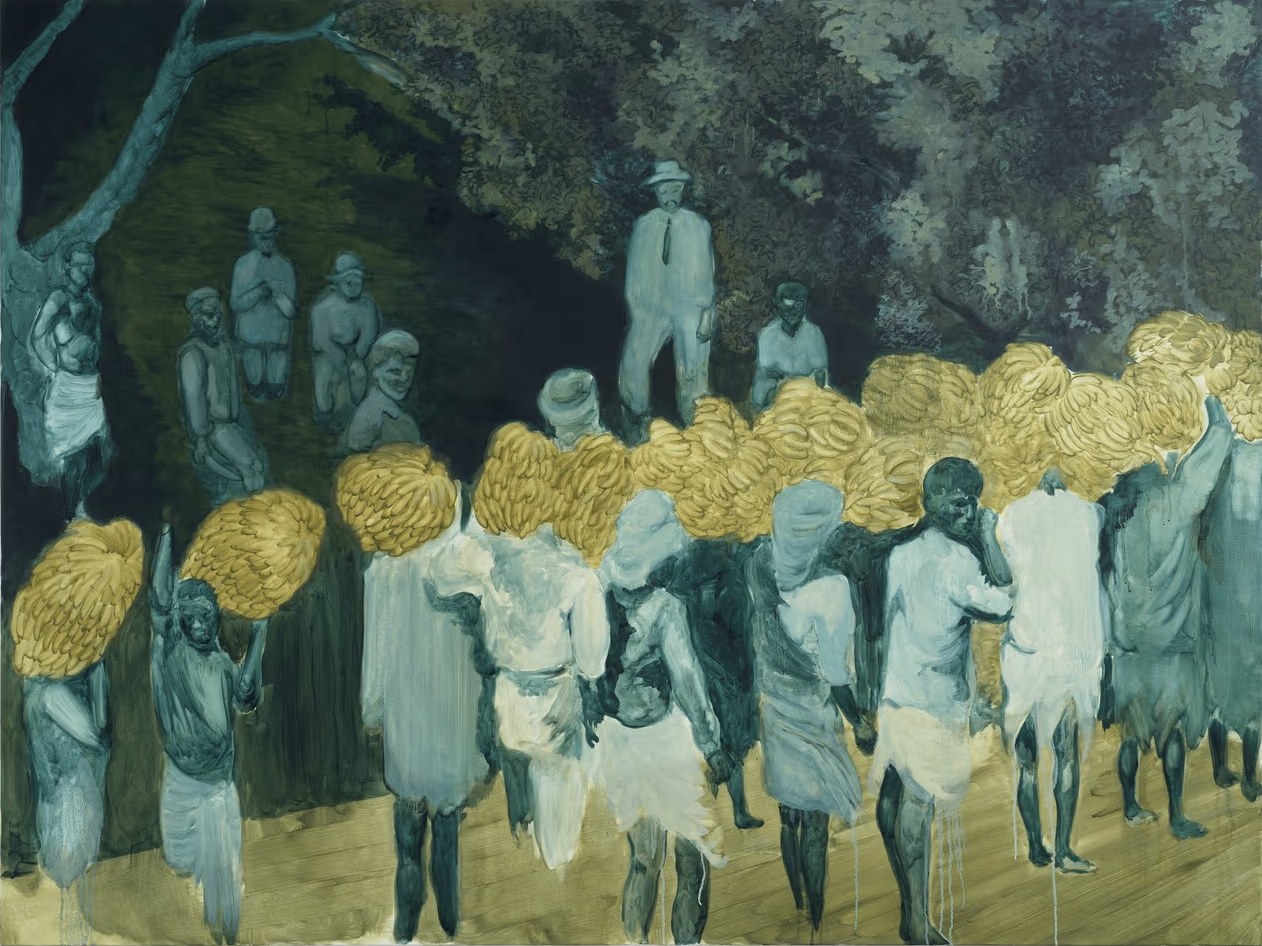
The Procession is copied, more or less, from a photograph. Pillay found it in 2024 in a box file at the provincial archives in Pietermaritzburg, labelled with the name of a farm near Port Shepstone and a year. In it, a line of men carry bunches of bananas on their heads towards a packing shed, and a man in a white suit stands on a step and watches them. Everything in the photograph is grey.
She kept almost all of that. The figures are the green-grey of a fishpond in winter, the trees behind them are close to black, and the man in the suit is still on his step. The one thing she changed was the fruit. The bunches are laid on thickly in a dull gold, the colour of a brass doorknob nobody polishes, and they are where everyone looks first.
“I did them grey for about a month,” she said. “They just looked like the men had rocks on their heads.”
The margarine tub
On the table beside her palette is a coil of faded cloth about the size of a saucer. It belonged to her great-grandmother, who worked on a farm near Izotsha in the 1930s and wore it on her head under whatever she was carrying. It spent sixty years in a margarine tub at the back of her grandmother’s wardrobe and twelve more in her mother’s. When her mother moved into a smaller flat, it came to Ravelle in a Checkers bag with two pillowcases and a cake tin.
She uses it to stand her coffee mug on. Asked whether anyone in the photograph might be family, she said it was the right farm and the year was close, and then asked whether anyone wanted more tea.
The last week
One figure is not in the photograph. Under the trees on the left, a man has turned round and is grinning straight out of the painting, the only face that looks back. She added him in the final week, over a patch of dark leaves, because that side “needed somebody awake”.
Near the bottom, the white of the men’s clothes has run down their legs in thin lines and onto the ground. That was a humid morning in February, with the paint thinned too far. She thought about scraping it back and decided she didn’t have a spare month.
The passage in Chatsworth
The painting was shown once, for three weeks in March, at a small gallery on Station Drive, and was not for sale. It now hangs in her mother’s flat in Chatsworth, on the long wall of the passage between the kitchen and the bathroom, because nothing in Umbilo had a wall that size. Her mother has put a narrow table underneath it. The cake tin is on the table.