Someone who paints
The painter
Louise Levin painted Nature’s Beauty at night, after the house had gone quiet, at a fold-out table in the laundry room of her Johannesburg home. Her family still calls that room, without irony, “the studio”.
She was born in 1972 and has spent most of her life in the city’s northern suburbs, raising three children in a house that for decades held no paintings of her own: only other people’s, and a great many school pictures under fridge magnets. She is entirely self-taught. She learned to mix a proper grey from her mother’s oil paints, kept for years in a biscuit tin for no reason she can now explain, except that she couldn’t bring herself to throw them out.
The painting
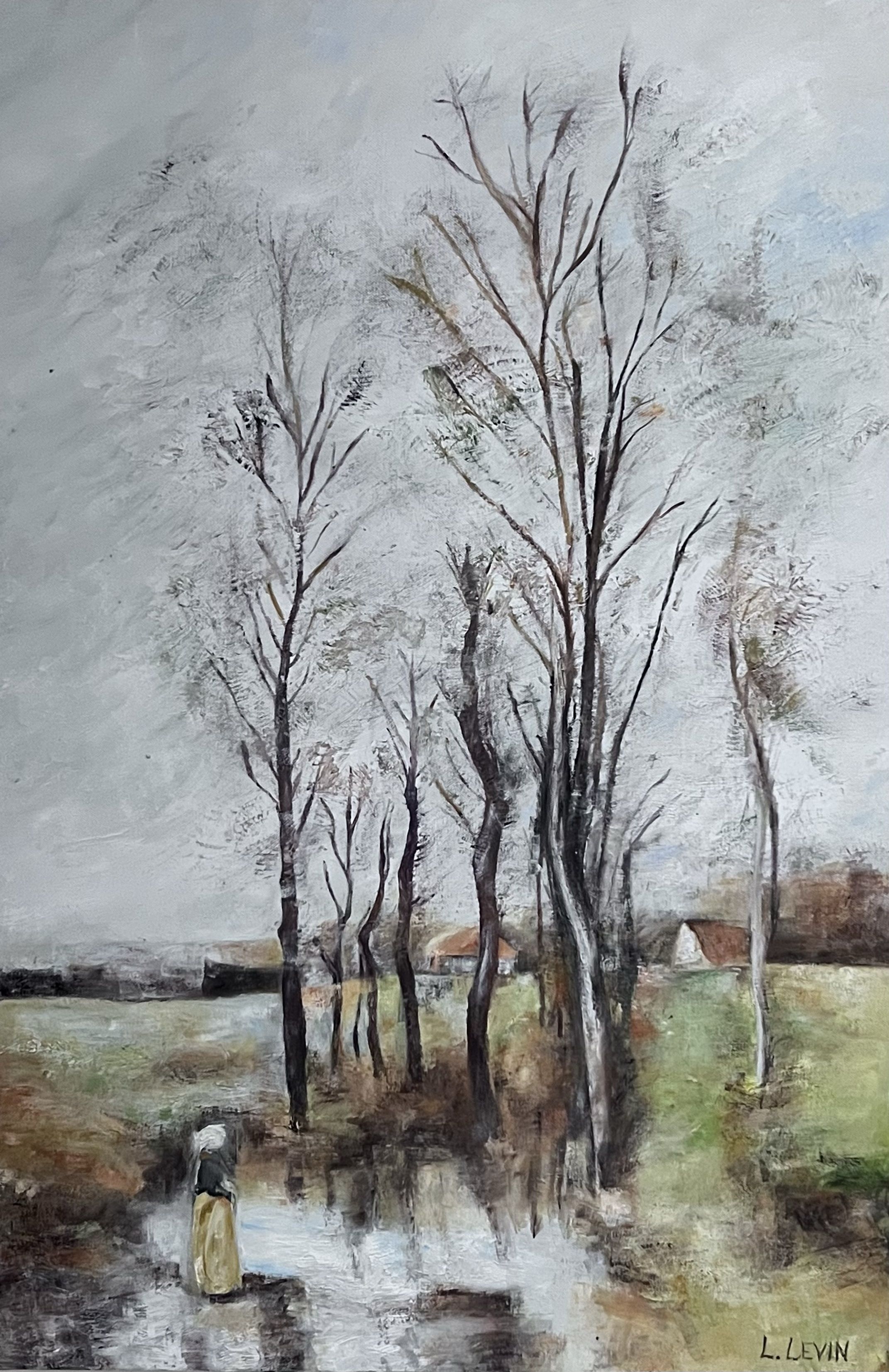
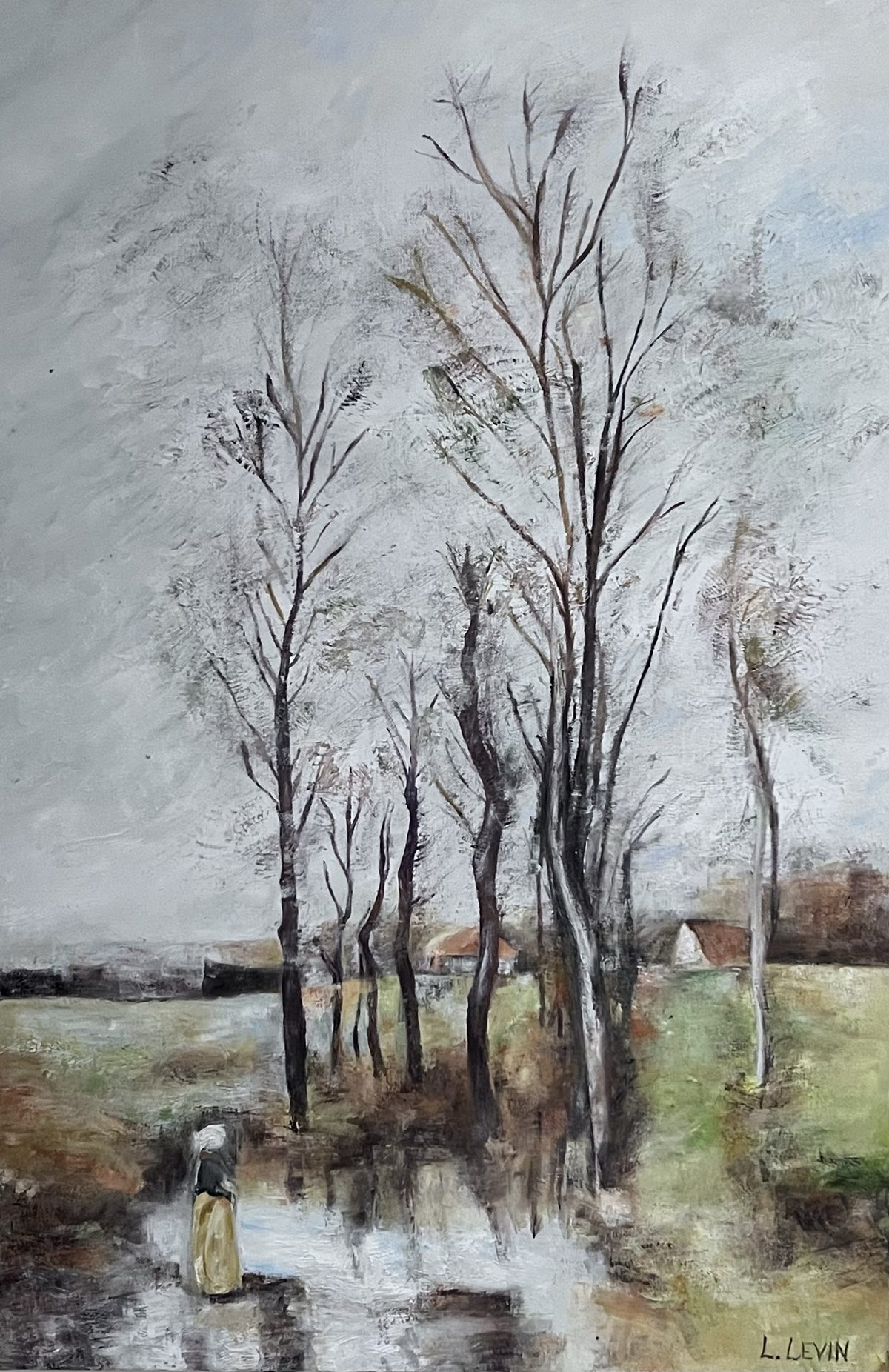
It began as an act of copying. Louise came across a reproduction of a nineteenth-century European landscape in a secondhand book (bare poplars, a flooded meadow, a low grey sky) and found she couldn’t put it down. She spent four months returning to it in the evenings, rebuilding it stroke by stroke from memory, the way she had once been taught to pick out a piece of music by ear. By the end it had become something of her own.
The composition holds nearly everything at a distance. A stand of bare trees, painted in the same soft grey-brown as the sky behind them, doubles itself in the flooded ground below, trunk and reflection meeting at a waterline that is barely there, so the upper two-thirds of the canvas reads as a single suspended, mirrored world. The palette stays close to ash, stone and dull gold, disciplined enough that the small warmth of a rooftop, glimpsed between the trunks, feels almost startling.
The woman in the water
The original had nobody in the foreground, and Louise had meant to leave it that way. Near the end, the stillness seemed to need one small, human note of scale and solitude standing inside it. She is a woman in a pale bonnet and a yellow skirt, ankle-deep in her own reflection, facing entirely away. She isn’t posed so much as caught, mid-errand, indifferent to being watched, which is what keeps the scene from tipping into simple prettiness.
What happened next
Nature’s Beauty hung in Louise’s dining room for the better part of a year before her daughter, without asking permission, entered it into a small community exhibition in Johannesburg. It sold on the second night, to a stranger who told her it reminded him of a place he couldn’t quite name.
Louise still isn’t entirely comfortable calling herself a painter. She prefers “someone who paints”, a distinction she insists is precision rather than modesty. In the years since, she has quietly filled two more rooms with work no one outside her family has seen. She says she’ll show them when they’re ready. She has said this about every painting she has ever finished.