The Scream of Nature
The evening
In January 1892, in Nice on the French Riviera, Edvard Munch wrote down an evening from back home in Norway. He had been walking along a road above the fjord with two friends. The sun was setting. Suddenly the sky turned blood red, with “blood and tongues of fire” above the blue-black fjord and the city. He stopped and leaned on the fence, exhausted. His friends walked on. He stood there trembling with anxiety, and felt, he wrote, “an infinite scream passing through nature”.
The road ran along Ekeberg hill, at the edge of what is now Oslo. People have argued for more than a century about what he actually saw that evening. Some have pointed to ash from the eruption of Krakatoa, others to rare mother-of-pearl clouds. Munch never said. His account is about what it felt like.
The man who wrote it
He was twenty-eight. His mother had died of tuberculosis when he was five, and his sister Sophie, the sibling he was closest to, died of the same disease when he was thirteen. His father was devout and given to dark moods. Another sister, Laura, spent much of her adult life in psychiatric care.
Years later, Munch wrote that “illness, insanity and death were the black angels that kept watch over my cradle”.
Painting it again
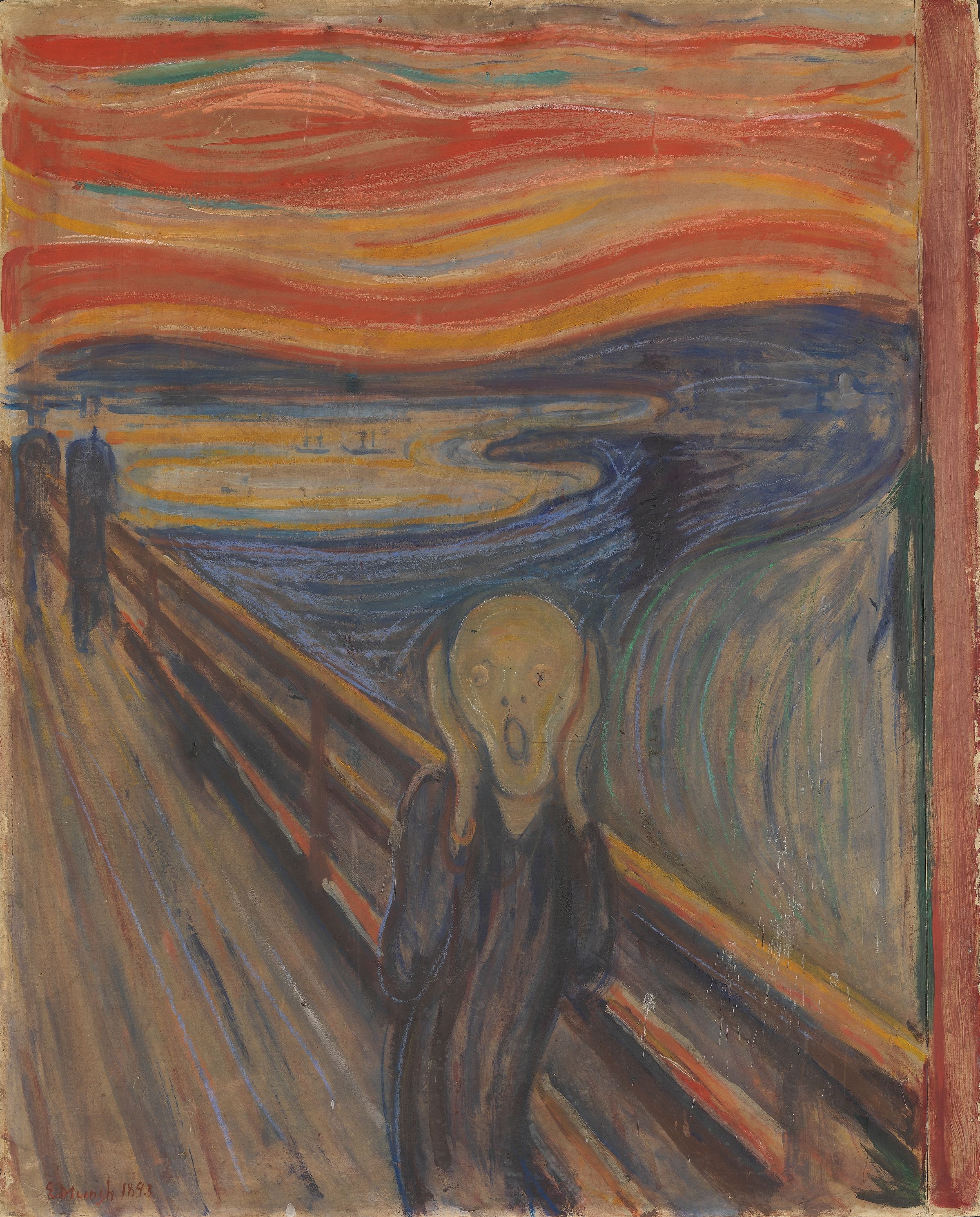
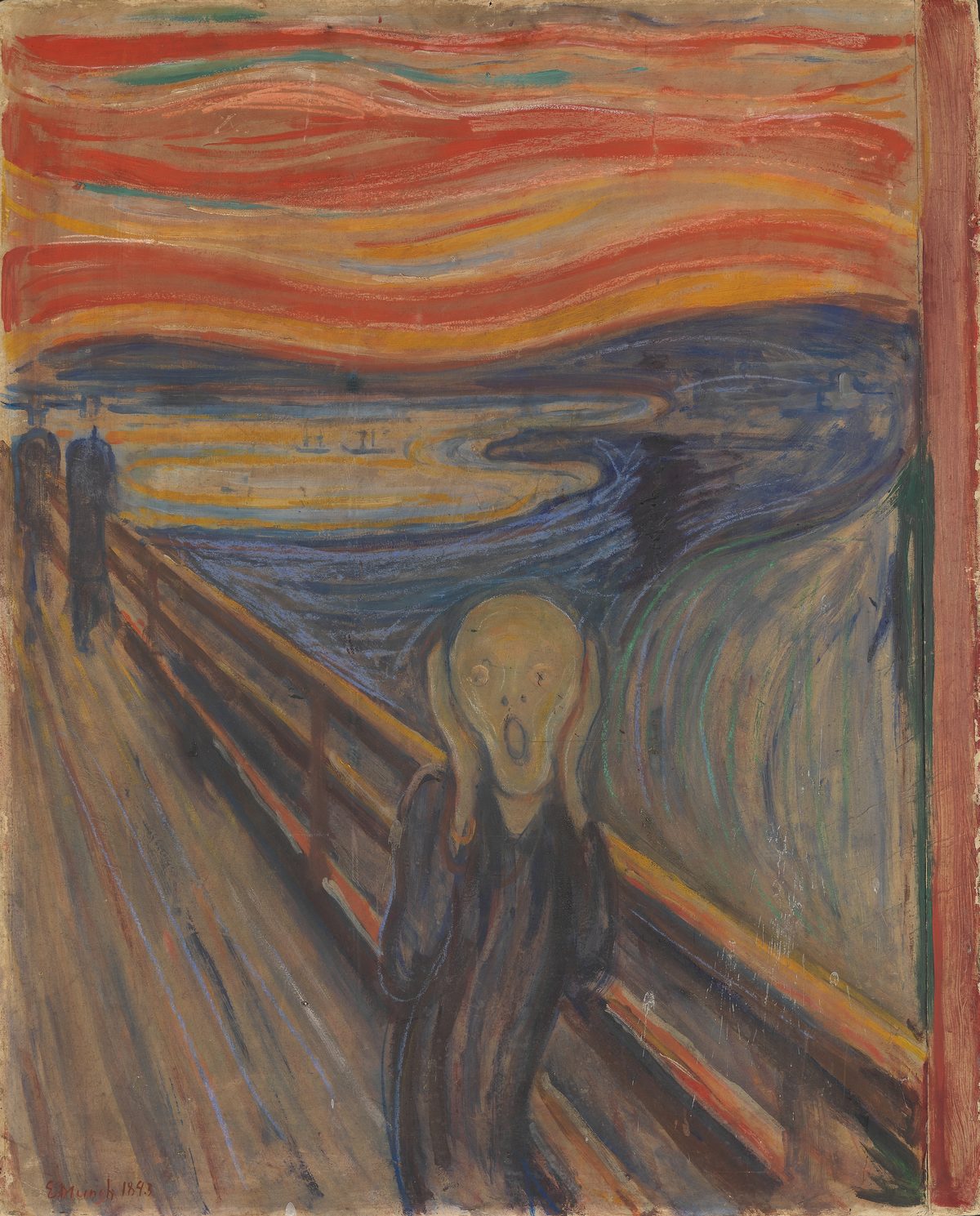
He tried more than once to paint the evening. In Despair, from 1892, a man in a hat stands at the railing under a red sky, an ordinary figure in an ordinary coat. In this painting, a year later, Munch took that man apart. The hat went, then the hair, the features, the age. What remained was a pale head like a skull and two hands pressed against it.
This is the evening as he remembered feeling it. The sky, the fjord and the hills move in the same long, bending strokes, and the figure’s body bends with them. Only the railing holds straight. Far up the bridge, two figures keep walking. He painted on plain cardboard, and in places the bare board still shows between the strokes.
His own title for it, in German, was Der Schrei der Natur: The Scream of Nature. Over time the name was shortened, and the scream is now usually read as coming from the face.
The sentence in the sky
In 1895, at a discussion evening at the Students’ Association in Kristiania, a medical student named Johan Scharffenberg argued that pictures like these showed their painter was not of sound mind. Munch is believed to have been in the room.
At some point, someone wrote in faint pencil across the red sky of this painting: “Kan kun være malet af en gal Mand!” Can only have been painted by a madman! For decades it was taken to be a visitor’s insult. In 2021, after comparing the writing with his notes and letters, the National Museum concluded it was in Munch’s own hand, most likely added in 1895 or shortly after.
What happened next
He returned to the image several times: a crayon version in 1893, a pastel in 1895, a lithograph that let it be printed in numbers, and a second painted version around 1910. In 2012 the 1895 pastel, the only version in private hands, sold at auction for $119.9 million, at the time a record for any work of art at auction.
This version was stolen from the National Gallery in Oslo in February 1994, on the morning the Winter Olympics opened in Lillehammer. The thieves left a note: “Thanks for the poor security.” It was recovered three months later. The second painted version was taken at gunpoint from the Munch Museum in 2004 and recovered in 2006.
Munch died in 1944, at his home outside Oslo, and left his remaining work to the city. The cardboard is now so fragile that the painting is shown in low light. The pencilled sentence is still in the sky, faint enough to pass unnoticed from a few steps away.