The joiner on the left
The rue du Helder
“I want it bigger than the room,” Géricault told his landlord in March 1818. “The door, I don’t care about the door. We take it off.”
They took it off. The canvas was a little over seven metres wide, and for the next eight months it leaned against the long wall of a rented studio on the rue du Helder, beside a stove that smoked whenever the wind came from the north. Géricault was twenty-six. He had his head shaved so that he would not be tempted out in the evenings, and he worked from first light until the landlord’s cat came looking for its supper at five.
He wanted the raft right before he painted a single body on it, so he hired a joiner.
Lucien Arnaud
Arnaud was forty-six and lived two streets away, above a baker. He charged four francs a day. Over three weeks in April he built a model of the raft on trestles in the middle of the studio, out of pine slats and tarred rope from a chandler near the river. When it was finished, Géricault asked him to stay on and sit.
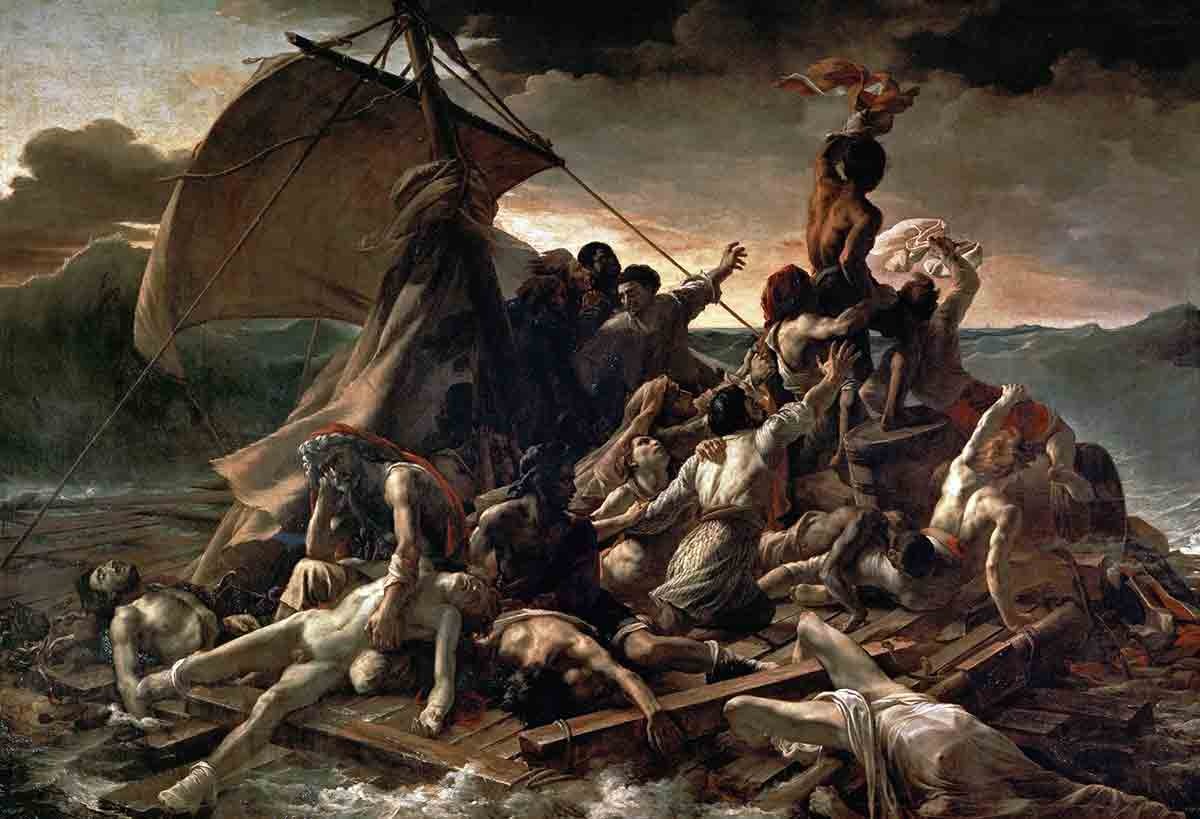
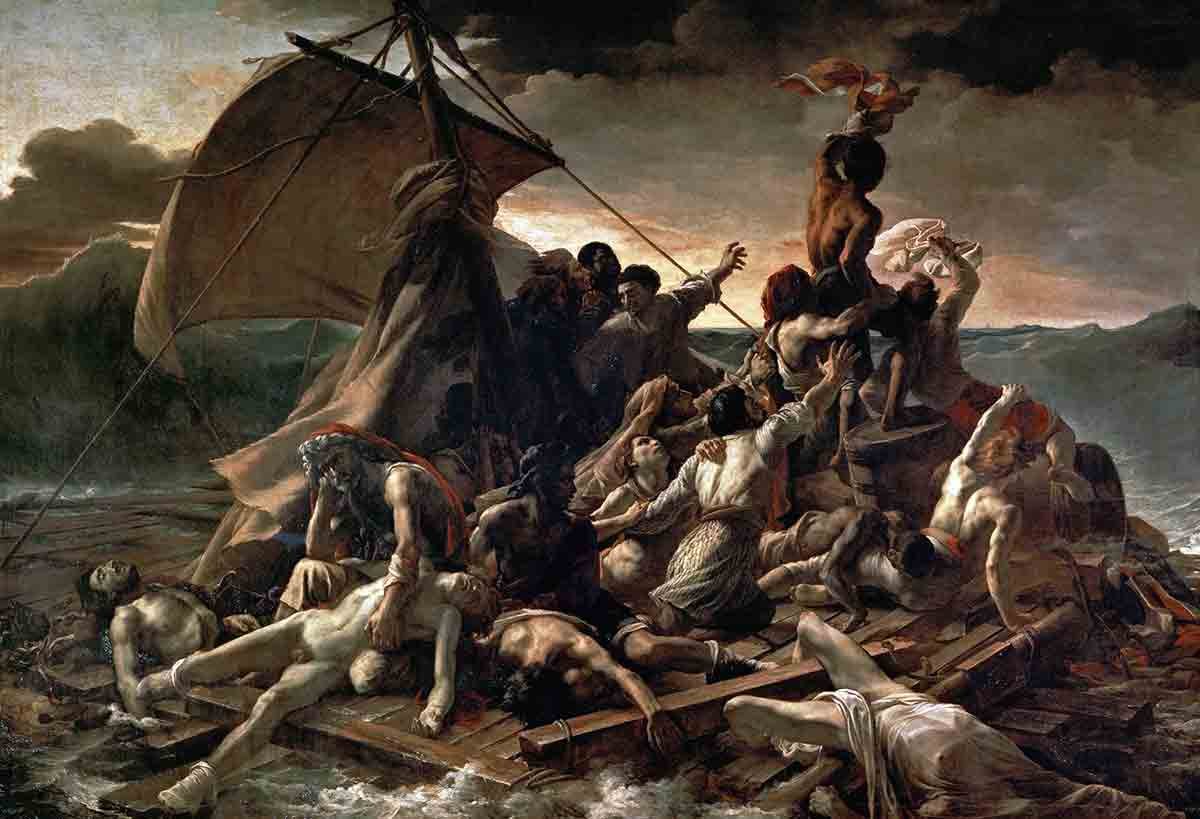
He is the old man on the left in the red cloak, with a body across his knees and his other hand against his face. The landlord, who kept the studio accounts, noted that Arnaud was paid on Saturdays and always asked for it in five-franc pieces.
He had been saving to open a workshop of his own since 1804. Each spring he told someone it would be next year. Each autumn the money went to his sister in Rouen, whose husband had a bad back and five children to feed, and Arnaud went back to working for other men.
“It’s a good shop I’m going to have,” he told Géricault once, while holding still. “Window on the street. I’ve drawn it.”
The hand
For most of the summer the old man’s free hand rested on the body’s chest. In the last week of October, Géricault painted it out and moved it up to the forehead.
The reason is in a letter to his friend Dorcy. On the Friday before, Arnaud had sat on a stool by the stove waiting for his wages, which were late, with his head in his hand. He had not noticed anyone was looking. “That was the man,” Géricault wrote. “Since April I am trying to paint him and there he is, waiting for money.”
Everyone else on the raft leans the other way, up the heap of bodies towards the man on the barrel waving a cloth at a ship too small to see. A faint second outline still shows under the red cloak where the first hand used to be. Whether Arnaud ever opened his shop, the accounts do not say. The last entry with his name is a payment of thirty-one francs, on a Saturday in November.
The stool
The painting went to the Salon the following August. Géricault gave up the studio in 1821 and left behind the trestles and the stool by the stove. It has three legs, one shorter than the others, because Arnaud cut it down to stop it rocking.
The next tenant, a hatmaker, kept it. It went down through his family and is now in a flat in Lyon, where a retired teacher stands on it to reach her top shelf. She knows where it came from. She has never been to the Louvre to see the hand.