A metre of red thread
The stall in Brixton
“He buys like a man who’s already decided, and then he argues for forty minutes anyway,” says Grace Owusu, who has sold Dutch wax cloth from the same corner of Brixton Market since 1998. Yinka Shonibare has been coming to her since before anyone asked him for interviews. He takes six yards at a time, never the full twelve, and pays from an envelope that, by Owusu’s count, has been in use for at least three years.
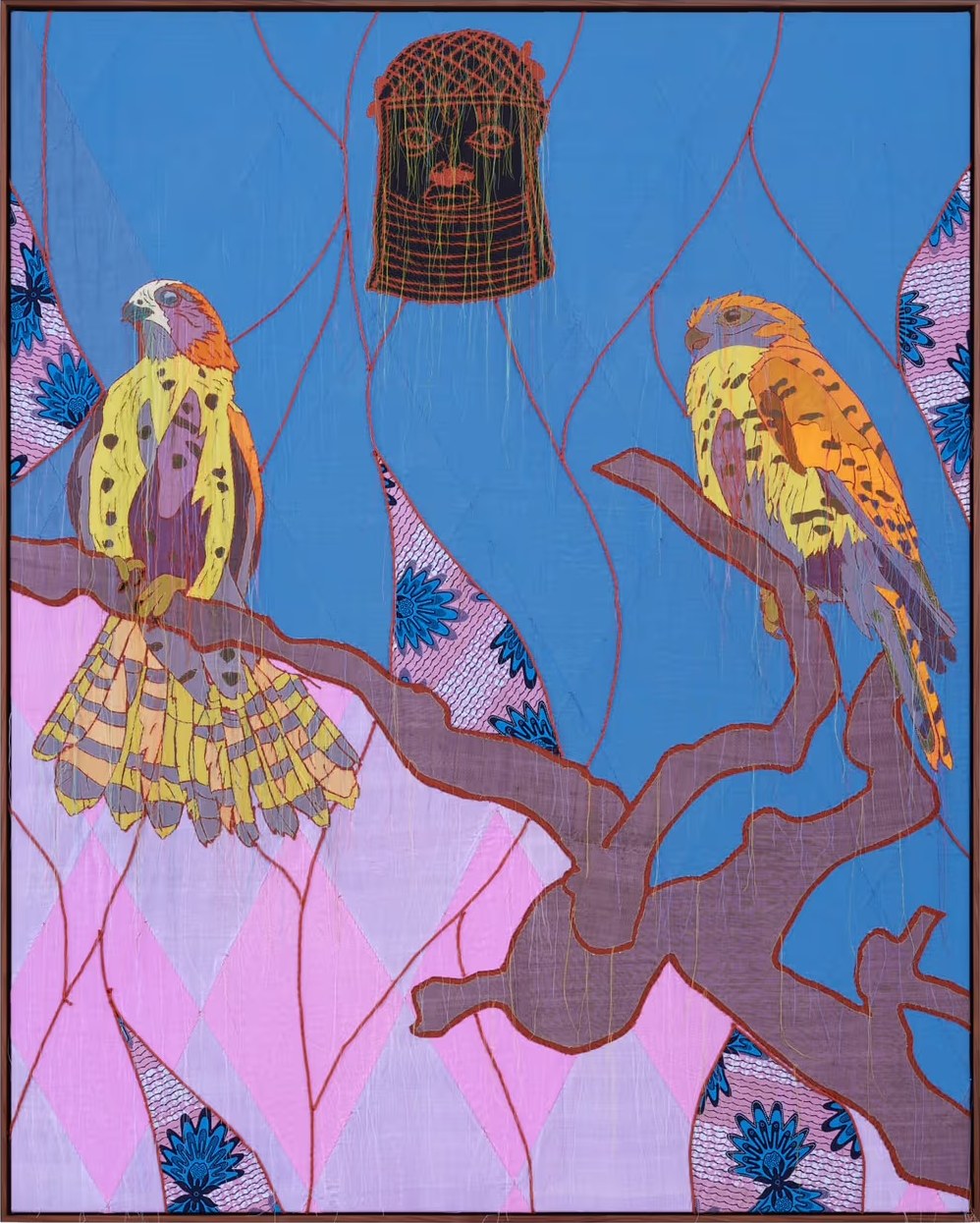
For African Bird Magic he bought a print she calls “the blue cabbage”, a flower pattern in cobalt and pink that she had stopped reordering because nobody wanted it. “I told him, that one doesn’t sell,” she says. “He said, good.”
Fourteen months
The quilt took fourteen months in the studio in Hackney, a former print works with a radiator that only heats the end nearest the door. Shonibare works there from eight until about three and then goes home to cook, a routine his assistant, Tomasz Wilk, describes as “very boring, which is how anything gets finished”.
The two Mauritius kestrels were pieced first, from silk he dyed himself in a plastic washing-up bowl. The yellow took unevenly, so the breast of the left bird is darker down one side. He kept it. The branch they sit on is cut from a single length of plum linen, about four metres, and the red line that runs around it, and on through the blue and the pink, is stitched by hand. Wilk counted roughly 2,000 stitches on the branch alone before he stopped counting.
The left kestrel faces you. The right one has turned its head away, towards the edge of the quilt, as if it heard something there.
The head in the net
Above the birds hangs the head of an Oba, a Benin king, cut from black cloth and laid under a net of red stitching that runs down over the face. It was the last thing added. In the photographs Wilk took during the making, that patch of sky stays empty blue until the final week of October.
The red thread for the net did not come from the studio’s stock. It came from a wooden spool that Shonibare brought in from home one morning, with a paper label written in a hand that is not his. He used most of it on the net and on the long loose ends that hang below the chin.
Asked where the spool came from, he said, “It was in a drawer.” Asked whose drawer, he talked for some time about the radiator.
Where it is now
The quilt was shown in London in the spring and bought by a collector in Lagos, who has hung it in a stairwell where it gets about an hour of afternoon light a day. The spool went back to the studio. It sits on the windowsill above the sink with something like a metre of red left on it, and Wilk says nobody is allowed to use it for anything else.