The concierge’s glass
Madame Roux’s account
“He came down in his slippers and asked for the glass the way you ask for salt,” Odile Roux told a reporter from a Paris evening paper in 1961. “A week, he said. I had it back in July.”
She was the concierge at 23 rue La Boétie for twenty-two years. The glass was a cheval mirror on two turned walnut posts, with a screw missing on the left side, so that it tipped forward unless you wedged it with a folded tram ticket. It had come with her from Clermont-Ferrand when she married, and it stood in the loge beside the coat hooks. Picasso, who was fifty that winter and lived with his wife and son on the floors above, had walked past it twice a day for years.
Upstairs
He carried it up himself, the glass and the stand in two trips, because he did not want the boy from the bakery touching it. The studio was on the top floor, in a room the rest of the household did not use. He worked there at night, usually from eleven until the first trams on the avenue, and slept until noon.
The model came on Tuesdays and Fridays. She was twenty-two and, according to Madame Roux, always early, so she waited in the loge and fed the canary bits of her croissant. “She asked me once if I thought she was pretty. I said that’s not my department.”
The floor
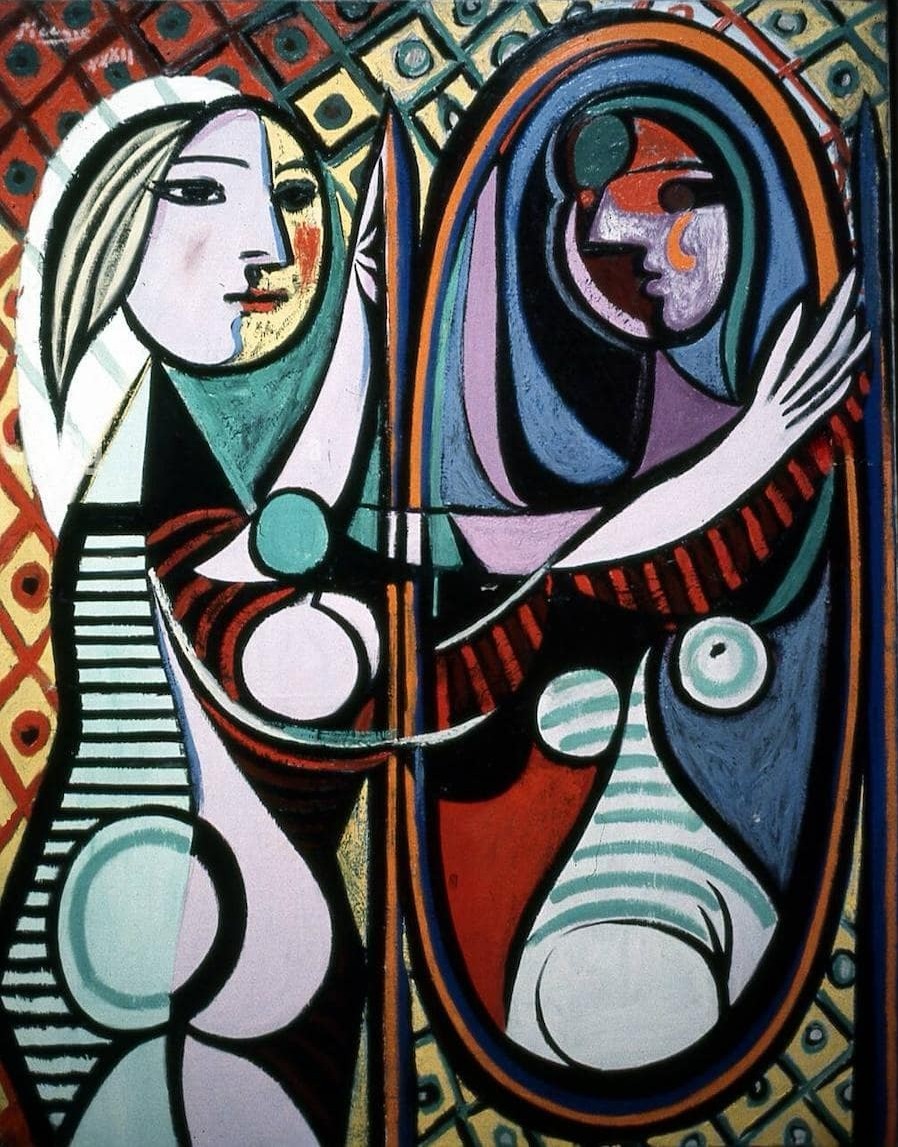
In the painting the girl stands on the left with her face in two halves, a pale lilac profile against a gold front view, and reaches all the way round the mirror to hold it. The wall behind her is covered in diamonds, each with a dot in the middle. That is the floor of Madame Roux’s loge, tile for tile. She recognised it before she recognised anything else.
The reflection is darker than the girl, and older. Madame Roux said he painted it three times. The first two versions looked like the model. He scraped both back with a kitchen knife, and the third time he left the face in deep red and purple, with one green eye.
What she told the dealer
In June a dealer named Lucien Vasse came to see the new work. Picasso showed him eleven canvases and kept one turned to the wall. On his way out Vasse stopped at the loge to ask for a taxi, and Madame Roux, who wanted her mirror back, told him there was a twelfth painting upstairs and that her floor was in it.
Vasse went back up. Picasso was annoyed. “It’s not finished,” he said, according to Vasse’s diary. “The one in the glass is still looking at me wrong.” Then he turned it round. It was in Vasse’s window by October. The mirror came down the stairs the same afternoon.
The receipt
When he borrowed the glass, Picasso had written her a receipt on the back of a gas bill: “Mme Roux, un miroir, rendu dans huit jours. P.” She kept it in her missal for thirty years. It is now in a plastic sleeve in a filing cabinet at a notary’s office in Clermont-Ferrand. Her grandson has been asked three times whether he wants to sell it, and has not yet given an answer.